

Migraines affect over a billion people worldwide and remain one of the leading causes of disability. For many, light is the most relentless trigger — harsh fluorescents, flickering LEDs, and glowing screens can turn an ordinary day into hours of agony. Patients often wonder: what color light helps migraines or what color light helps with headaches?
Surprisingly, studies show that not all light is harmful. Green light therapy for migraines can calm pain pathways, while red light supports cellular repair. Instead of hiding from brightness, patients may soon find that specific wavelengths of light can actually heal.
Migraine and Light – An Uncomfortable Relationship
For many patients, artificial lighting is the worst culprit. Yes, LED lights can cause headaches, especially for people prone to migraines. The flicker, glare, and harsh spectrum of modern bulbs overstimulate sensitive brain pathways.
The science shows why: special retinal cells connect light directly to the brain’s pain hub (the thalamus). When harsh light hits, pain signals flare. That’s why researchers began asking: if some wavelengths are harmful, could others be therapeutic?
Understanding Migraine as a Neurological Disorder
Migraines are not caused by stress or dehydration alone. They are a neurological condition, ranked by the WHO among the top global causes of disability.
Symptoms Beyond Head Pain
Unlike tension headaches, migraines often come with a cluster of neurological symptoms:
- Aura: strange visual disturbances like zig-zag lines, blind spots, or flashing lights.
- Sensory overload: sensitivity not only to light, but also to sound, smell, and even touch.
- Nausea and vomiting: making everyday tasks almost impossible.
- Cognitive fog: trouble finding words, slowed thinking, and difficulty focusing.
A Full-Body Experience
These symptoms show migraines are more than head pain — they are a whole-body disorder rooted in how the brain processes sensory input.
The Photophobia Puzzle
One of the most distinctive features of migraines is photophobia, or light sensitivity, which affects nearly 90% of sufferers. This reaction is linked to photosensitive retinal ganglion cells (pRGCs), which connect the eyes directly to the thalamus, the brain’s pain center.
When exposed to harsh light — especially blue and red wavelengths — these cells amplify pain signals, intensifying migraine symptoms. That’s why brightly lit environments often feel unbearable, while softer lighting provides relief.
Light Therapy Basics: Green vs Red
Light has always played a complicated role in migraine care. On one hand, patients search desperately for tips on how to prevent headaches from LED lights or how to minimize the harsh effects of fluorescent bulbs. On the other, researchers are finding that certain wavelengths may actually be therapeutic.
This raises a fascinating question: what is the best light color for headaches? The answer isn’t one-size-fits-all, because green light therapy for migraines and red light therapy work in completely different ways.
The Green Light Approach: Calming Pain Pathways
- Acts through the eyes and directly interacts with retinal cells.
- Produces the weakest electrical signals in the brain, making it less likely to worsen photophobia.
- Clinical trials show reduced headache days and improved sleep quality.
- Often described as the best light color for headaches because of its consistent soothing effect.
The Red Light Approach: Repairing at the Cellular Level
- Penetrates skin and tissues, acting directly on cells instead of the visual system.
- Boosts mitochondrial energy (ATP), reduces inflammation, and improves blood flow.
- Evidence in migraines is newer, but strong in related pain conditions like fibromyalgia and neuropathy.
Why the Comparison Matters
Instead of focusing only on avoiding harmful bulbs, like people often do when asking how to prevent headaches from LED lights, science suggests we should also ask: what color light actually helps migraines? That’s where green and red come into play — one calms, the other repairs.
Green Light Therapy for Migraines: Calming the Storm
Green light therapy is emerging as one of the safest non-drug alternatives to traditional Headache & Migraine Treatment, offering relief without side effects.
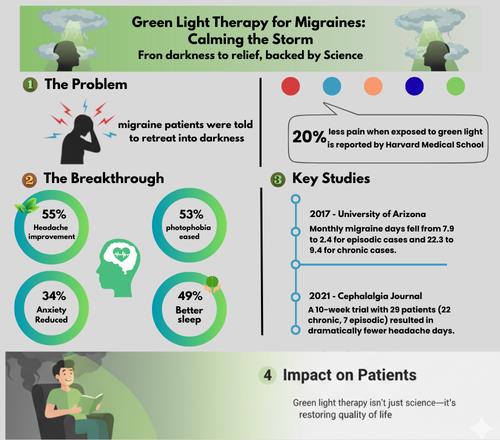
For years, migraine patients were told to retreat into darkness. But research shows that a specific wavelength of green light can soothe headaches instead of worsening them — leading to the question: how does green light therapy work?
Breakthrough Studies That Changed the Conversation
- Harvard (2016): Patients reported 20% less pain under green light compared to red, blue, amber, or white.
- University of Arizona (2017): Green light reduced headache days from 7.9 to 2.4 in episodic cases and from 22.3 to 9.4 in chronic cases.
- Cephalalgia (2021): A 10-week trial confirmed similar reductions in headache frequency.
- Frontiers in Neurology (2023): Real-world users reported 55% headache relief, 53% less photophobia, 34% less anxiety, and 49% better sleep.
These results show that green light therapy delivers more than lab curiosity — it offers meaningful relief in everyday life.
How Does Green Light Therapy for Migraines Work?
Why does green light succeed where other colors fail? The answer lies in how the migraine brain processes signals.
- Weaker Retinal and Cortical Signals: Green light produces the smallest electrical responses in both the retina and the cortex, meaning it doesn’t overstimulate the nervous system.
- The Thalamus Connection: This brain region acts like a “pain amplifier.” Blue and red light crank up its activity, while green tones it down.
- Overlap with Migraine Medications: Interestingly, green light impacts the same thalamic regions where CGRP inhibitors (a new class of migraine drugs) act — suggesting light therapy may be a drug-free way of calming these pathways.
Studies show that green is the only color that consistently soothes headaches rather than intensifying them.
How to use green light for migraines
Some of the best green light for migraine options include the Allay Lamp and NorbRELIEF bulbs, both designed with therapeutic wavelengths. Patients often wonder: how to use green light for migraines in daily life? Clinical studies provide clear guidelines:
- Wavelength: 515–535 nm narrow-band green light.
- Intensity: 4–100 lux (low brightness compared to sunlight).
- Duration: 1–2 hours daily, ideally in a dark room.
- Eyes open: Benefits occur only when light reaches the retina.
Best Green Light for Migraines: Devices That Actually Help
- Allay Lamp — designed specifically for migraine relief by Harvard researchers.
- NorbRELIEF Bulbs — affordable, flicker-free bulbs for home use.
- Avulux Glasses — block harmful wavelengths while allowing soothing green light through.
Strengths and Limitations
- ✅ Non-invasive, safe, no reported side effects.
- ✅ Reduces pain, light sensitivity, anxiety, and improves sleep.
- ❌ Requires daily consistency (effects usually appear after 3–4 weeks).
- ❌ Limited by small-scale studies — larger trials are still needed.
Takeaway: Green light therapy stands out as one of the most promising drug-free tools for migraine care. With the right devices and consistent use, it may finally give patients a way to face light without fear.
Green Light Therapy vs Red Light Therapy: Complementary or Competitive?
At first glance, green light therapy and red light therapy might look like competitors — two different wavelengths fighting for attention in the migraine world.
But when we dig into the science, it becomes clear they’re less rivals and more two halves of the same coin. Each targets migraine relief from a different angle, and together they may form a powerful, drug-free toolkit.
Key Differences in Action
- Green Light: Think of it as a neurological “mute button.” It calms the hyperactive pain circuits in the brain, especially the thalamus, making light itself more tolerable during a migraine.
- Red Light: This is more of a cellular “repair crew.” It goes deeper, improving mitochondrial health, reducing inflammation, and increasing blood flow to prevent future attacks.
Comparison Table: Green vs Red Light Therapy
Researchers have long debated the best light color for headaches — with green showing the strongest clinical evidence so far
| Feature | Green Light Therapy | Red/NIR Light Therapy |
| Primary Target | Pain-processing pathways in the brain (via retina → thalamus). | Cellular function (mitochondria, oxidative stress, vascular health). |
| Mode of Action | Produces weakest retinal/cortical signals, calms photophobia. | Boosts ATP, reduces inflammation, promotes vasodilation. |
| Best For | Reducing light sensitivity, easing pain during/around attacks. | Building long-term resilience, lowering attack frequency. |
| Scientific Evidence | Multiple migraine-specific studies (Harvard 2016, Arizona 2017, Cephalalgia 2021, Frontiers 2023). | Early migraine studies + stronger evidence in chronic pain conditions (fibromyalgia, neuropathy). |
| Therapy Protocol | 515–535 nm, 1–2 hrs/day, low intensity (4–100 lux). | 600–700 nm (red), 800–900 nm (NIR), 10–20 mins, 2–3 times/week. |
| Devices | Allay Lamp, NorbRELIEF bulbs, Avulux glasses. | Handheld wands, LED panels, NIR helmets. |
| Drawbacks | Needs consistent daily use, effects build slowly. | Protocols not standardized, possible eye strain with overuse. |
So, if you’ve ever asked what color light helps with headaches, the research consistently points to green, with red offering long-term benefits.
Complementary Potential
Instead of asking “Which is better?” The smarter question may be “How can they work together?”
- Green for Comfort: During or around an attack, green light can make environments more tolerable, ease photophobia, and even reduce pain intensity.
- Red for Resilience: Between attacks, red light may strengthen cells and blood flow, reducing the brain’s overall vulnerability to migraine triggers.
This complementary model calming the storm with green while reinforcing the foundation with red could represent the future of migraine therapy.
Early anecdotal reports already suggest patients experimenting with both see improvements on multiple fronts, but controlled trials are still needed.
Is Light Therapy the Future of Migraine Care?
For decades, migraine care has revolved around medication and avoidance. But patients now ask: is green light therapy real or just another wellness trend? Early research shows it’s real, though still developing.
Green light reduces photophobia and headache days, while red light strengthens cellular health. Together, they represent one of the most promising drug-free approaches to migraine care.
Why Patients Are Paying Attention
- Non-drug approach: No side effects like drowsiness, weight gain, or rebound headaches.
- Accessibility: Lamps, bulbs, and panels are increasingly available for home use.
- Versatility: Beyond migraine, light therapy may also improve sleep, anxiety, and mood — conditions that often overlap with migraine.
The Challenges Ahead
- Standardization: While studies highlight effective ranges (515–535 nm for green, 600–900 nm for red/NIR), there’s no universal agreement yet on dosing, timing, or device specifications.
- Evidence gap: Green light has stronger migraine-specific trials; red light’s migraine evidence is still in its infancy. Larger, multi-center randomized controlled trials are urgently needed.
- Quality control: The market is flooded with “green bulbs” or “red panels” that aren’t designed with therapeutic wavelengths. This can dilute results and create skepticism.
The Promise of a Paradigm Shift
Despite the unknowns, light therapy may change how patients see their condition — literally. Instead of fearing brightness, they can learn what color light helps with headaches and use it as a tool for healing.
It’s not a cure, but it could reduce attacks, ease sensitivity, and improve quality of life for millions of migraine sufferers.
A Bright Future Ahead
So, what color light helps migraines? Current research points strongly to green light as the most effective option for soothing pain and easing light sensitivity, while red light plays a valuable role in long-term cellular repair and resilience.
The debate over the best light color for headaches continues, but combining green for comfort and red for prevention may offer patients the best of both worlds. Light, once feared as a trigger, could soon become a trusted ally in migraine relief.