

| ⚡ Quick Facts: Dehydration & Headaches 💧 Just 1–2% fluid loss can trigger a dehydration headache 💧 The brain temporarily shrinks when dehydrated, pulling against the skull 💧 Dehydration is one of the most common and preventable headache triggers 💧 Resolves within 30 minutes to several hours 💧 Dehydration can also cause chest pain, vision problems & rapid heartbeat |
That dull, pounding pressure behind your eyes or across your forehead might not be stress or a migraine. It could be your body’s most direct signal: you are dehydrated.
Dehydration headaches are among the most common and most preventable types of head pain. Yet they are frequently misidentified and mismanaged. Understanding exactly what a dehydration headache feels like can help you respond faster and recover sooner.
At Glow Primary Care in East Northport, NY, our board-certified physicians evaluate patients experiencing recurring or unexplained headaches every day. Here is what you need to know.
What Is a Dehydration Headache?
When your body loses more fluid than it takes in, blood volume drops, and oxygen delivery to the brain decreases. The brain can temporarily lose fluid and pull slightly away from the skull, activating pain receptors and producing that familiar, unwelcome headache.
Even mild dehydration of just 1–2% of your body’s water can be enough to trigger head pain, fatigue, and difficulty concentrating.
What Does a Dehydration Headache Feel Like?
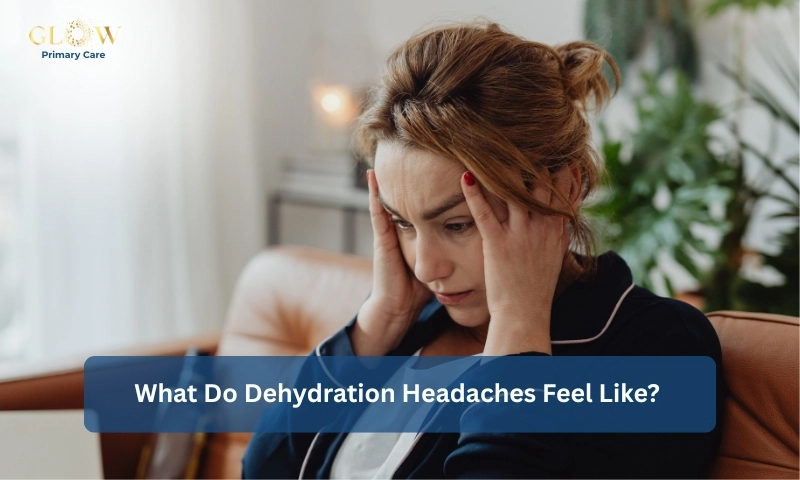
Patients frequently ask: What does a dehydration headache feel like compared to a regular headache? The distinction lies in three key characteristics:
| Pain & Location Dull, throbbing ache affecting the whole head, not sharp or one-sided | Aggravated By Bending forward, standing quickly, or any head movement worsens the pain | Onset Pattern Builds gradually, commonly after exercise, heat, illness, or a night without water |
| Dehydration Headache Symptom Checklist You may be experiencing a dehydration headache if you notice: ✅ Dull, throbbing pain across the entire head ✅ Headache worsens when you move or stand up ✅ Dry mouth and increased thirst ✅ Dark yellow urine or reduced urination ✅ Fatigue, dizziness, or difficulty concentrating ✅ Muscle cramps or general weakness ✅ Headache began after exercise, heat, alcohol, or illness |
Can Dehydration Cause More Than Just a Headache?
Yes, and the severity of additional symptoms often signals how dehydrated you are.
• Chest pain: Reduced blood volume strains the heart, causing palpitations or tightness.
• Vision problems: Blurred or double vision can occur as blood pressure drops.
• Sore throat: Prolonged fluid loss dries out mucous membranes, causing throat irritation.
• Rapid heart rate: Dehydration causes the heart to beat faster as the body compensates for reduced blood volume, leading to palpitations or a racing heartbeat
| Recurring headaches in East Northport or Long Island?Same-day appointments available, our physicians identify the root cause, not just the symptom.→ Book Your Appointment at Glow Primary Care |
Dehydration Headache vs. Migraine: Key Differences
Because dehydration is a known migraine trigger, the two conditions often overlap. Knowing the difference matters because migraines require targeted clinical treatment that rehydration alone cannot address.
| Feature | Dehydration Headache | Migraine |
| Pain Type | Dull, throbbing, whole head | Pulsating, usually on one side |
| Onset | Gradual (hours without water) | Can have aura/warning signs |
| Nausea | Possible in severe cases | Very common |
| Light Sensitivity | Mild/absent | Severe (photophobia) |
| Relief | Resolves with rehydration | Requires medication |
| Duration | 30 min – several hours (with fluids | 4 – 72 hours |
If your headache does not improve after consistent fluid intake, or if neurological symptoms accompany it, a clinical evaluation at Glow Primary Care is the appropriate next step.
How to Treat a Dehydration Headache
When caught early, dehydration headaches respond well to a straightforward treatment protocol:
1. Rehydrate steadily — Drink 1–2 liters of water over 1–2 hours. Avoid large amounts all at once.
2. Restore electrolytes — Water alone may not be enough. Use oral rehydration salts or an electrolyte drink.
3. Rest in a cool space — Reduce physical activity and avoid direct heat or bright light.
4. Take an analgesic if needed — Ibuprofen or acetaminophen can help, but always take with food and fluids.
5. Adjust your diet — Include water-rich foods: cucumber, watermelon, celery, and citrus.
When to Seek Urgent Care for Dehydration
At-home rehydration is appropriate for mild cases. But certain symptoms indicate the need for urgent care for dehydration. Do not delay if you notice any of the following:
| Seek Urgent Care Immediately If You Experience: ⚠️ Headache persists beyond 3–4 hours despite drinking fluids ⚠️ Confusion, disorientation, or sudden behavioral changes ⚠️ Chest pain, rapid heartbeat, or shortness of breath ⚠️ Fainting or inability to stand without severe dizziness ⚠️ No urination for more than 8 hours ⚠️ Symptoms in children, elderly patients, or those with diabetes |
These presentations require IV fluids, electrolyte monitoring, and full clinical evaluation, resources that are available right here at Glow Primary Care.
When to Visit Glow Primary Care for Your Headaches
Frequent headaches, even when dehydration-related, deserve a proper clinical evaluation. Relying on over-the-counter medications without understanding the root cause can delay treatment of underlying conditions.
At Glow Primary Care, our board-certified internal medicine physicians offer comprehensive headache assessments, on-site lab testing, lifestyle counseling, and same-day appointments. We serve patients across East Northport, Huntington, and greater Long Island.
| Ready to get to the root of your headaches?Visit Glow Primary Care — East Northport, NY | Same-Day Appointments | Most Insurances Accepted→ Book Now at Glow Primary Care |