

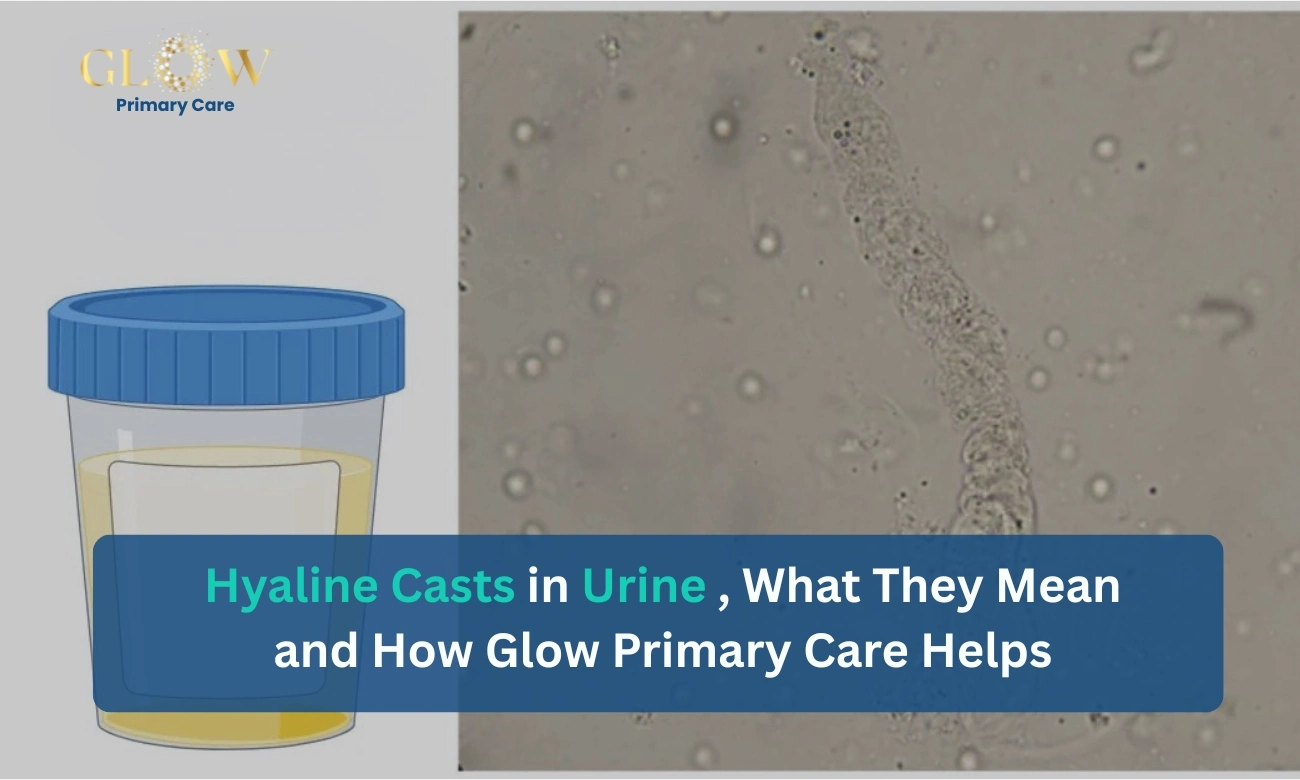
Seeing “hyaline casts in urine” on a lab report can feel alarming. At Glow Primary Care, we review results like this every day and explain what it means for you, whether it’s a normal finding after a workout or a sign we should look closer. Our goal is clear next steps, not confusion.
Hyaline casts are tiny, protein-based molds formed in the kidney’s tubules. A few hyaline casts can be normal, especially with dehydration, fever, or strenuous exercise. Persistent or numerous casts or casts with other urine abnormalities deserve a clinician review to rule out kidney stress and guide testing or follow-up.
What you’ll get from Glow in this guide: plain-language answers, a decision tree for next steps, and exactly how our team evaluates, monitors, and treats concerns, plus when we fast-track you to a kidney specialist if needed.
Are hyaline casts normal?
Sometimes, yes. When urine is concentrated (dehydration, fever, first-morning sample) or after strenuous exercise, a small amount of hyaline casts can appear in healthy people.
Normal range (how labs report it)
- Many labs report hyaline casts as “casts per low-power field (LPF)” or simply “present/absent.”
- Trace/occasional often 0–2 per LPF is commonly considered within normal limits.
- Reference ranges vary, so we interpret your result in context (symptoms, hydration, medications, and the full urinalysis).
If your report says “few/occasional” and you were dehydrated or did a hard workout, we typically suggest hydration + a 24–48 hour exercise pause, then a repeat urinalysis (all within primary care).
When isn’t it normal?
We look more closely when any of the following apply:
- Persistent or higher counts on repeat testing not explained by dehydration or exercise
- Other UA changes alongside casts: protein, blood, or very concentrated urine
- Risk factors like diabetes, high blood pressure, heart/kidney disease, or pregnancy
- Symptoms such as swelling, foamy urine, reduced urine output, flank pain, or uncontrolled blood pressure
What causes hyaline casts in urine?
The kidney’s Tamm–Horsfall protein can gel in concentrated or slow-moving urine, so hyaline casts often show up with dehydration, fever, first-morning urine, or strenuous exercise.

Concentrated or Slow-Moving Urine
Hyaline casts form more easily when urine is concentrated or passes slowly through the kidneys. This happens with dehydration, fever, or first-morning samples.
Exercise and Heat
Heavy workouts or training in hot, humid conditions can concentrate urine and increase casts temporarily. This typically improves with rest and good hydration.
Medications and Fluid Shifts
Certain medicines, like diuretics, or conditions causing vomiting, diarrhea, or heavy sweating, can reduce body fluids and raise cast counts. At Glow, we review your medications and recent illnesses to identify reversible causes.
Pregnancy-Related Changes
Normal hormonal and fluid shifts during pregnancy can lead to mild, short-term findings. We closely monitor blood pressure and urine protein, provide hydration guidance, and repeat the test as needed.
Chronic Health Conditions
People with hypertension, diabetes, or known kidney disease may show hyaline casts alongside other findings, such as protein or mild kidney-function changes. In these cases, we perform a primary-care evaluation and, if needed, coordinate referral for further review.
What Should You Do Next?
If you feel well and your report shows few or occasional casts, it’s usually temporary. Stay hydrated, rest from intense exercise for a day or two, and schedule a repeat urinalysis.
If the repeat is normal, no further action is typically needed.
If the test shows higher counts or additional findings like protein or blood, book a primary-care review. We’ll assess your hydration, medications, and health history and may order basic labs—such as the albumin-creatinine ratio (ACR) or basic metabolic panel (BMP)—to monitor kidney function.
If you have swelling, visible blood in urine, severe pain, fever, or uncontrolled blood pressure, contact us the same day. During pregnancy, new swelling or high blood pressure also deserves prompt evaluation.
If symptoms are severe, seek urgent care or emergency services immediately.
What we do at Glow when your report shows hyaline casts
Triage & context
Quick check of symptoms; recent dehydration/illness/exercise/heat; medication review (diuretics/NSAIDs, etc.); overall risk profile.
Verify UA details
Collection quality; specific gravity; protein/blood; leukocytes/nitrites; reported cast counts.
- Right-sized testing (PCP)
- Low concern → hydrate + 24–48h exercise pause → repeat UA
- Ongoing concern/persistent findings → consider basic labs: urine ACR and BMP/eGFR
- Lab-based urine microscopy may be requested where appropriate (within PCP scope)
Primary-care management
Hydration guidance, blood pressure/diabetes counseling, safe NSAID use discussion, and practical lifestyle pointers (salt, heat, training adjustments).
Follow-up timing
Normal repeat → reassurance. Mild/stable abnormalities → 2–12 week trend checks. Significant or worsening changes → expedited primary-care review.
Referral coordination (when needed)
If abnormalities persist or the overall picture is concerning, Glow Primary Care coordinates referral. We do not describe specialist treatments on the site.
Clear communication
Plain-language portal summaries, what we’re monitoring, which tests are next, and when you’ll hear from us—so you’re never guessing.Our goal: the right checks without over-testing, clear timelines, and calm, informed next steps.
Our goal: the right checks without over-testing, clear timelines, and calm, informed next steps.
FAQ’s
Reminder: Online information is general education. Your lab needs personalized interpretation. We’re happy to review it with you and map out next steps.